

Read the healthcare data breach 2026 headlines quickly and you’d think the worst is behind us. HHS logged 397 large breaches in the first half of the year, the lowest H1 total since 2023. Fine. But nine of those incidents each exposed over a million people, and the biggest passed 5.8 million. IBM now says the average healthcare breach costs $6.64 million. And the HIPAA Security Rule overhaul everyone was waiting on? Pushed to July 2027. So no, hospitals aren’t safer. The danger just changed address. The numbers below come from HHS filings, IBM’s 2026 cost study and breach notices that went public in recent weeks.
397 Breaches, Nine Mega-Incidents: The Mid-Year Scorecard
Let’s start with the good news, because there isn’t much. In the healthcare data breach 2026 count, large breaches fell 5.9% compared with H1 2025, and the number of people affected dropped 22.6%. Providers took 290 of the 397 hits. Business associates had 59, health plans 48. That spread says something: it’s the everyday clinic and mid-sized practice getting hammered, not only the giant systems you read about.
June alone brought 66 large breaches and nearly 4.5 million affected people. HIPAA Journal’s line, that more than two a day is the new normal, feels about right. The first quarter was nastier on impact: 200 breaches, 17.1 million people, up 29.4% from a year before. April was a lull at 47, well under the 12-month average of 62.4, but one slow month doesn’t make a trend.
Cause? Same culprit as always. Hacking and IT incidents lead and went up again. All but two of the twenty biggest cases were hacking or ransomware. Lost laptops and stolen paper barely register, with just two cases in six months. Security teams don’t have to guess what’s coming. They have to ask how attackers get in.
Why Is Your Vendor the Weakest Link in 2026?
A lot of the year’s biggest incidents started somewhere other than the hospital. CareCloud, a healthcare IT provider, says intruders got into its AWS cloud environment between March 10 and 16. More than 3.7 million patients were affected and its service went down for eight hours. Letters started going out July 25, and the company still hasn’t said what was taken beyond patient names. A healthcare data breach 2026 story often begins just like this, with a vendor most patients have never heard of.
RXNT, an electronic health record vendor, reported unauthorized access to one platform on March 1 to 3. Several clients confirmed exposure, and RXNT offered to handle the regulatory notices for them. Navia Benefits Solutions, which administers employee benefits, touched more than 2 million people. One vendor falls, dozens of providers inherit the problem.
Then there’s the wait. Cookeville Regional Medical Center in Tennessee started mailing notices to more than 337,000 patients on April 14, about nine months after a ransomware attack in July 2025. Comparitech counted 134 confirmed ransomware attacks on US providers in 2025, with 11.7 million records exposed. Its researcher made a fair point: when organizations stay vague or quiet for months, patients are left open to phishing and identity theft.
Healthcare Data Breach 2026 Costs: Still the Priciest of Any Industry
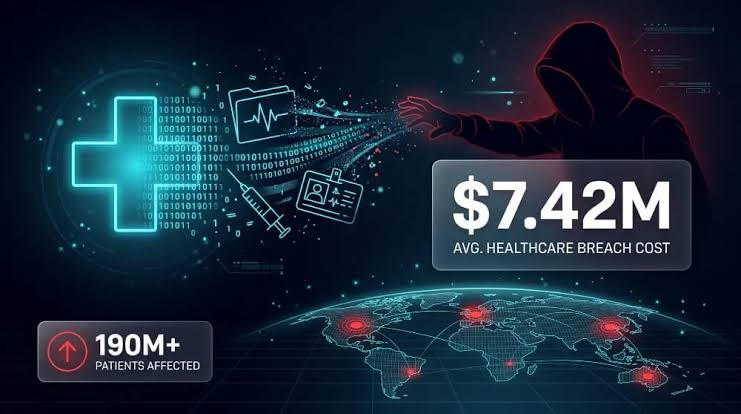
IBM published its 2026 Cost of a Data Breach Report on July 29. Healthcare came first for the thirteenth year running, at $6.64 million per breach. That’s down 10.5% from $7.42 million last year. Across all industries the global average hit a record $4.99 million, and US organizations averaged $11.5 million.
Don’t treat the drop as a win. Paubox argues healthcare fell while other sectors rose mostly because of where the costliest breaches happened to land, not because defenses improved. Malicious attacks cause 59% of healthcare breaches. AI-driven attacks rose 56% and tack on roughly $1 million. And finding plus containing a breach now takes 247 days on average across industries, slightly worse than before.
Time costs money. Breaches that ran past 200 days averaged $5.65 million, versus $4.32 million for faster ones. Teams leaning hard on AI and automation shaved 65 days off and saved about $1.93 million. Phishing is still the top way in, which is a boring but real reason to keep funding email security.
The Security Rule Everyone Expected Isn’t Coming Until 2027
HHS proposed a major rewrite of the Security Rule. Annual risk assessments, multifactor authentication spelled out as required. The target for the final version was May 2026, but the OMB agenda now says July 2027. Hospitals and health systems fought it, sending nearly 5,000 comments about cost and timelines they called unrealistic.
Regulators haven’t gone quiet in the meantime. OSF Healthcare agreed to a $552,250 settlement announced July 30. Assured Imaging agreed to pay $375,000 earlier this year. According to one analysis, weak risk analysis is still the most common Security Rule failure OCR finds, and the current rule remains fully in force.
One major HIPAA change did take effect this year: updated Notices of Privacy Practices for substance use disorder records, due February 16. That’s it. Anyone telling you the cybersecurity overhaul is already law is ahead of the facts. When it comes to healthcare data breach 2026 compliance, you still answer to the old rule.
Four Questions Patients and Administrators Keep Asking
How many healthcare data breaches have been reported in 2026?
By June 30, HHS had 397 reports of breaches affecting 500 or more people. By April 30 it was 252, about 9.5% fewer than the same window in 2025. Treat both as minimums. Several entries carry placeholder figures of 500 or 501 while investigations continue, so totals creep up.
What is the largest healthcare data breach 2026 has produced so far?
The biggest one reported in the first half hit more than 5.8 million people. AdaptHealth, at roughly 4.1 million, and CareCloud, at over 3.7 million, sit near the top too. Rankings shift as forensic reviews finish, so check the HHS Office for Civil Rights breach portal for current numbers.
What should I do if my health data was exposed?
If a healthcare data breach 2026 notice shows up in your mailbox, read it closely and take any free identity protection offered. Watch for messages that use leaked details to sound legit, and don’t give out more personal information or click odd links. A credit freeze is worth thinking about, and so is scanning insurance statements for services you never used.
Is the HIPAA Security Rule changing in 2026?
Not this year. Final action has slipped to July 2027, so the existing rule still governs. The one binding change in 2026 is the privacy notice update for substance use disorder records, due February 16.
The Real Deadline Is Set by Attackers
Boiled down, the healthcare data breach 2026 story is this: fewer big breaches get reported, yet the ones that land still reach millions, and many trace back to a vendor patients couldn’t name. Federal rules are late, so the pressure comes from attackers and costs. Map your vendors. Catch intrusions earlier. Keep doing risk analysis, every year, even when nobody’s making you. That’s how you end up explaining a near miss instead of mailing hundreds of thousands of letters.