

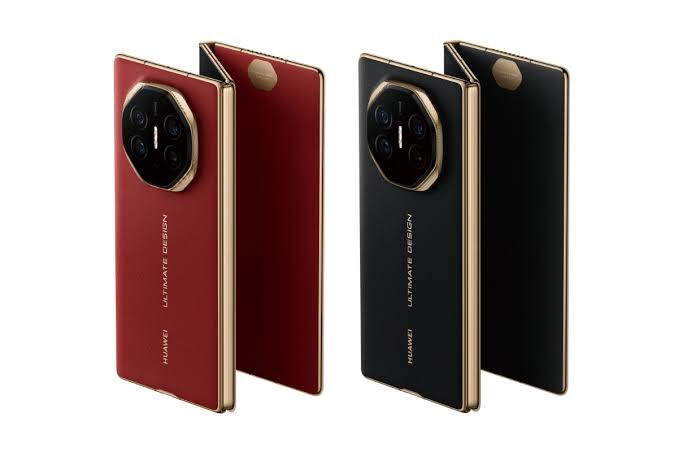
Try finding a Huawei Mate XT 2 right now and you’ll understand the story. Huawei unveiled it on September 7 and opened sales five days later. By September 29, Richard Yu, head of the company’s consumer business, told journalists that demand was running ahead of supply. About 100,000 phones had shipped by then. He expects the total to pass one million, the same milestone the first two tri-folds reached.
Why the rush? Because the first Mate XT was a showpiece. Gorgeous, sure, but the big screen faced outward, and anyone who carried one probably flinched every time it went into a bag. Huawei has now turned the whole thing around.
It folds inward, and that changes how you’d use it
Picture a book closing. The two side panels swing over the large display and cover it up. Nothing delicate is exposed anymore. On top of that, Huawei added a 6.5-inch screen on the outside, so with everything shut you’ve basically got a big normal phone. Reply to a message, check directions, pay at a counter. No unfolding needed.
Fully open, the display grows to 10.2 inches. It’s an OLED at 3K resolution, and the refresh rate slides anywhere from 1Hz to 120Hz depending on what you’re doing. The body is 3.5mm thick at its thinnest and weighs 299 grams. Huawei says that’s the lightest tri-fold on sale. There’s also IP58 and IP59 protection, and that surprised me, given how many moving parts sit inside.
Here’s the part Huawei’s marketing won’t dwell on. Closed, the phone is 12.3mm thick. That’s a brick. A reviewer at The Gadgeteer said it isn’t light, simple or cheap, and I can’t really argue. If you want something slim for your jeans pocket, look elsewhere. What this gives you is a tablet-sized screen that happens to fit in a pocket at all.
Privacy screen, fresh chip, a battery that came in smaller
Huawei calls this the first foldable with a built-in privacy display. Double-tap the edge of the cover screen and the viewing angle narrows, so someone peeking from the next seat sees almost nothing. It’s built into the panel itself, not a software trick. You can only get it on the top 1TB model, which costs 1,000 yuan more than the ordinary 1TB.
Power comes from the Kirin 9050 Pro, a chip that debuted with this phone. Engadget says it’s 42 percent quicker than what the original Mate XT used. The battery is a bit of a letdown next to the rumors. Leaks said 6,000mAh, but the finished phone has 5,600mAh. You get 66W wired charging and up to 50W wireless.
Will that last all day with the huge screen on? Honestly, nobody outside Huawei knows yet. Proper battery tests will answer that.
The phone runs HarmonyOS 7, which pushes AI hard. There’s an on-device assistant named Celia, and AI agents sit across the system. The trade-off is the one Huawei buyers already know: Google apps aren’t there in the usual way. Check that your banking and work apps exist before you pay close to three thousand dollars.
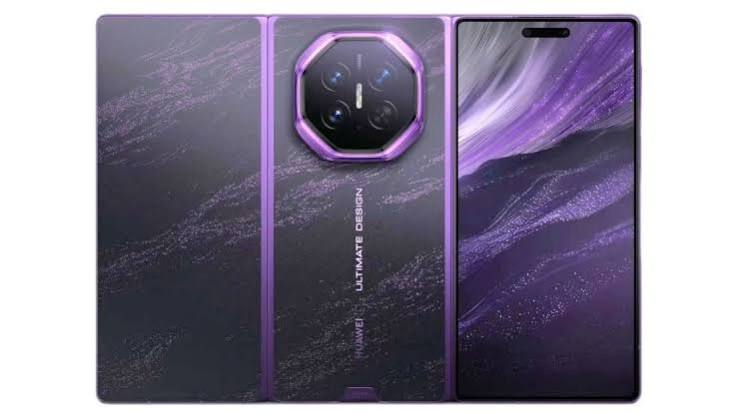
The cameras are better than they have any right to be
For something this thin, the camera list is long. The main one is a 50MP sensor, 1/1.28-inch, with variable aperture and optical stabilisation. Beside it you’ll find a 40MP ultra-wide and a 50MP periscope with 3.5x optical zoom. A fourth sensor is multispectral and exists to keep colours accurate. The big octagonal bump is back too.
Selfie cameras are 8MP, one on the cover screen and one inside, and both handle face unlock. This matters more than it sounds. Because there’s an outer display, you can do a video call or take a selfie without opening anything. The first model never allowed that.
What it costs, and who should skip it
The 256GB version is 19,999 yuan, around $2,979. The 512GB is 21,999 yuan and the 1TB is 23,999. The 1TB with privacy display is 24,999 yuan, and there’s a 2TB collector edition at 29,999. All of them come with 16GB of RAM.
That’s serious money, so think about what you actually do on a phone. Splitting the screen between a document and a call? Reading long PDFs? Editing on the move? Then yes, this is the one device that gives you a big canvas and still shuts down to normal size. If you mostly message, scroll and take photos, an ordinary foldable does nearly the same for a fraction of the price.
Huawei Mate XT 2 questions, answered quickly
How much does the Huawei Mate XT 2 cost?
In China it starts at 19,999 yuan for 256GB, roughly $2,979 at launch rates. A few US-facing sites list about $2,899, but that’s an estimate. Huawei hasn’t announced official prices for other countries.
When did the Huawei Mate XT 2 go on sale?
September 12, five days after the launch event. Stock has been tight since then, and Huawei admits it.
Is the Huawei Mate XT 2 coming outside China?
Yes, slowly. Yu said Huawei will bring it to overseas markets, mentioning strong interest in the Middle East and Asia Pacific, and said he’d like to reach Europe. The US is excluded because of the restrictions placed on Huawei in 2019. No dates yet.
Is the Huawei Mate XT 2 waterproof?
It has IP58 and IP59 ratings, which cover dust and water splashes. Drops and bent hinges aren’t covered, so use a case and be careful.
Bottom line
The Huawei Mate XT 2 is the first tri-fold that doesn’t feel like a science project. Folding inward, the cover screen and the privacy panel each fix something real. If you’re outside China, hold on for a bit. Official prices and software details aren’t out, and they’ll decide whether this is a smart buy or just an expensive one.